Technology · Three.js and WebGL

Three.js product configurator agency.

A 3D scene is only a demo until it can price, take payment and send the order to production. Your buyers configure in 3D, see the price, and the order reaches production as a full spec.

The Door Builder Canada storefront, showing a custom front door on a residential home.

The storefront buyers land on. Every door in the catalog opens into the configurator.

The short answer

SBFS builds real-time Three.js and WebGL product configurators as part of the channel they sell through, not as a standalone scene, because the results come from the rules behind it. Door Builder went from about two and a half weeks per quote to four minutes, Muebles Torga cut customer-service tickets by 72%, and Pepart's preview is re-rendered at 300 DPI as the print file. Door Builder and Muebles Torga run Three.js in production; Pepart runs React Three Fiber with a 2D canvas fallback.

Updated: Nov 2026

Pilot, one-time$4,000
Full channel launchSix weeks
Live demos11 industries
Code and dataYours
01— Fit

When does a custom Three.js configurator make sense?

Your product has to be seen to be sold

A made-to-order product is not on any shelf, and no photo shows the exact combination the buyer is about to pay for.

The scene is not the hard part

Option rules, pricing, checkout and the admin behind the scene are where configurator projects actually stall.

It has to work on the devices your buyers have

Pepart ships a 2D canvas fallback for browsers without WebGL, because a blank canvas is a lost order.

02— Capabilities

What does a Three.js configurator agency build?

Live 3D built around your product

A live 3D view built from your product's real shapes, with materials and lighting matched to your brand and range instead of a stock template.

Three.js and React Three Fiber, both shipped

Door Builder and Muebles Torga run Three.js configurators; Pepart runs React Three Fiber. All three are live in production.

A fallback for browsers without WebGL

Pepart buyers preview a piece in 3D or staged in a room, with a 2D canvas fallback so a buyer on an old browser still sees it and still checks out.

The scene wired to rules and price

The configurator only offers combinations you can build and the price resolves from the same option model, so the render and the order cannot disagree.

03— Proof

Which Three.js configurators run in production?

The Door Builder Canada storefront, showing a custom front door on a residential home.
Canada · United States

Door Builder

Custom doors, residential & commercial

Read case study
2.5 weeks → 4 min
Quote turnaround

Quotes that took Door Builder's sales team about two and a half weeks now take a dealer four minutes. Dealers design, price and order doors on their own, residential and commercial pricing applies by itself, and every order that comes in is a door the shop can actually build.

The Muebles Torga storefront: a headline over the category bar, an item count, and the first row of modular TV compositions.
Spain

Muebles Torga

Modular furniture systems

Read case study
−72%
Customer-service tickets

Customer-service tickets fell 72% once customers could no longer order Torga furniture parts that don't fit together. Dealers now manage their own orders, and when one needs help, Torga staff can step into the dealer's account to sort it out.

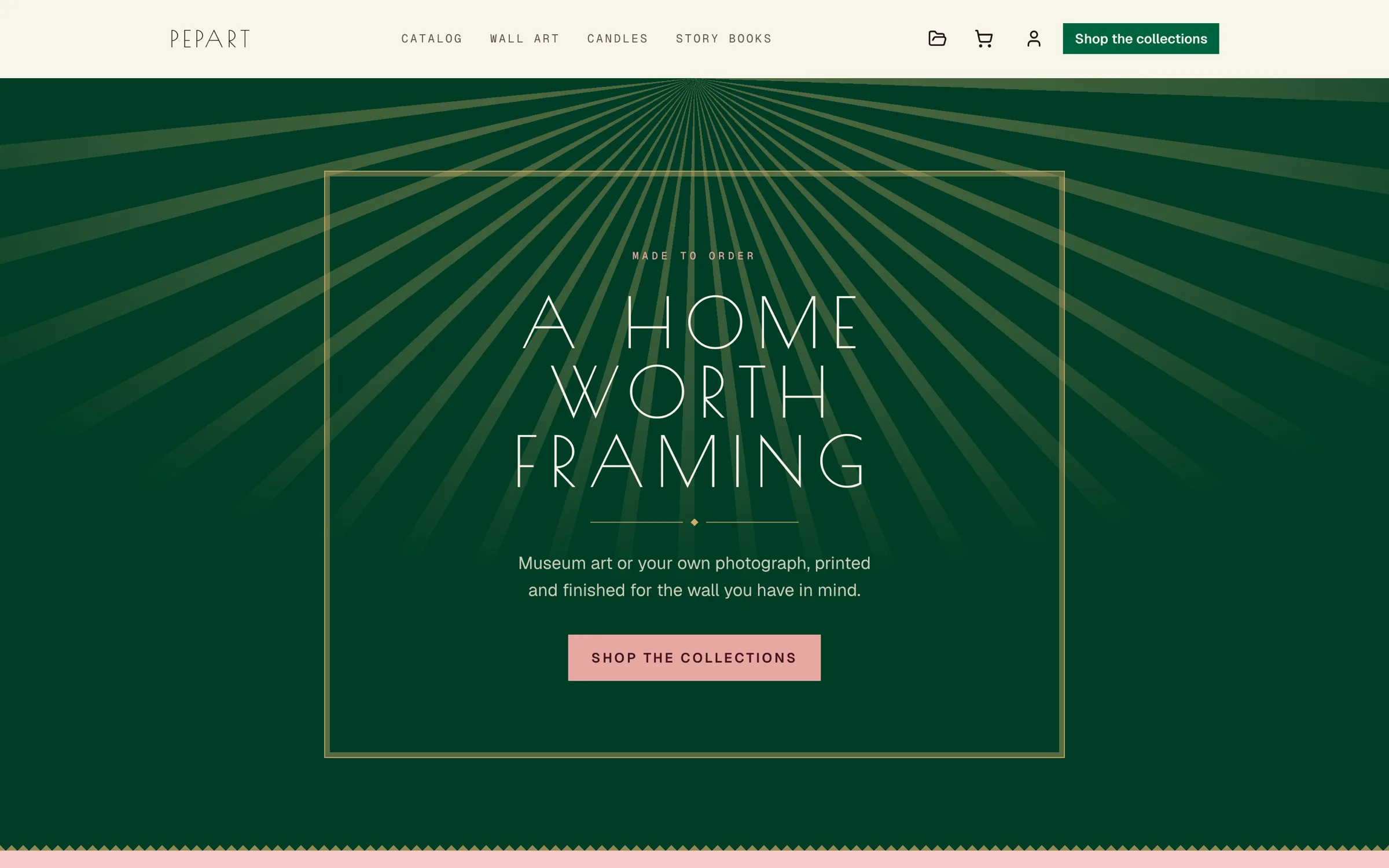
The Pepart storefront home page for made-to-order framed wall art.
United States

Pepart

Framed posters, made on demand

Read case study
Preview = print
What buyers see is what ships

What Pepart's customers see on screen is exactly what arrives at their door: their crop and frame choice become the print, with nothing lost in between. Every paid order then goes to print and ships without anyone touching it.

04— Method

How an engagement runs

01

Diagnose · about a week, included

We model your product range, the option rules behind it and the geometry the scene needs, then write the spec. You see exactly what we will build before we start.

02

Build · quoted in Diagnose, inside your tier

Scene, configurator UX, pricing rules, checkout and admin ship in parallel, with a reviewable demo every Friday on your own test site.

03

Operate & improve · after launch

Launched on your domain, then we stay on: new product lines, rules, prices and integrations, under the monthly fee of your tier. The code and data are yours.

05— FAQ

Questions buyers ask before they commit.

We build the configurator, not only the scene: the 3D, the option rules and the pricing behind it, integrated into the store, ERP or CRM you already run or as part of the full channel. A render with no rules behind it rarely pays for itself, and we will say so in Diagnose.

Both, depending on the app. Door Builder and Muebles Torga run Three.js; Pepart runs React Three Fiber. The choice follows the product rather than a house preference.

They still buy. Pepart previews in 3D or staged in a room, with a 2D canvas fallback so the piece is visible and the checkout still works.

We publish our prices: a one-time Pilot, then build tiers priced in ranges, because a configurator that resizes the product within your fabrication rules and one that runs your whole sales operation are different jobs. Each build tier is a one-time setup plus a monthly fee for running and improving it. Pilot: $4,000 one-time, for your own product live in a working 3D configurator on your own site, priced, with the full fee credited to the build if you continue. Parametric: $20,000–$40,000 setup and $500–$1,500 a month, for any size the buyer types in, your fabrication rules, files for production, and a connection to your online store or ERP. Forge: from $50,000 setup and a monthly fee scoped with you, for your whole sales operation, from catalog to checkout, on a platform you own. For Parametric and Forge, Diagnose is included and ends with a quote inside your tier. The full channel typically ships in six weeks, and Diagnose sets the date for yours.

You own all of the source code, the platform framework included, and the data. It runs on Vercel and Neon in the region you choose, on your own accounts or on ours while we operate it.
06— Related

Related solutions

Industry · Door manufacturers

3D configurator development for door manufacturers

Doors are configured, not stocked: slab, lite, panel, hardware, finish, size. Your buyers and dealers price that catalog live, and production gets an order it can actually build.

Industry · Print on demand

Print-on-demand storefront development

Print on demand has a trust problem: the buyer cannot see what will arrive. On your storefront the preview and the print file come out of the same pipeline, so what they see is what arrives.

07— Free tools

Try the free tools, no sign-up.

09— Get in touch

Send us one product. See it live, priced, in a business day.

Fastest way to start

Book the 20-minute call for your free demo

Pick a time and you'll get a Google Meet invite. We agree on one of your products and its options, and within one business day you see it working on a private link. No slides and no sales pressure.

Book a 20-min call
Rather send details in writing?juan@sbfs.co

Goes straight to Juan, who usually replies within 24 hours. If we cannot take your project on, we will tell you fast.

Product briefemails juan directly

Fields marked * are required.

Your name, role and company.