Industry · Print on demand

Print-on-demand storefront development.

Print on demand has a trust problem: the buyer cannot see what will arrive. On your storefront the preview and the print file come out of the same pipeline, so what they see is what arrives.

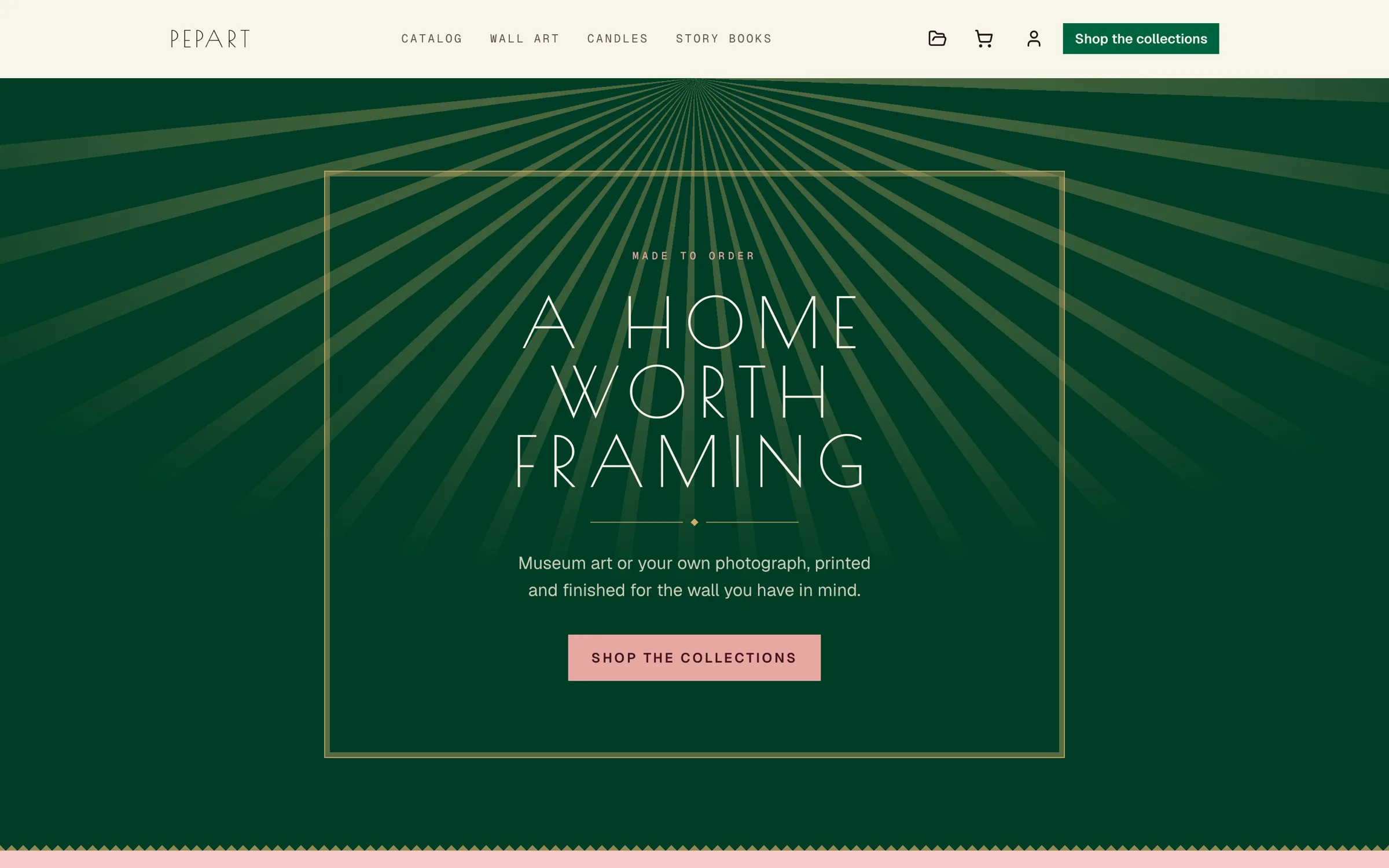
The Pepart storefront home page for made-to-order framed wall art.

The storefront for made-to-order framed art, where every piece is configured before it is printed.

The short answer

SBFS builds print-on-demand storefronts where the on-screen preview is the print. For Pepart we built a real-time 3D frame configurator whose pan-and-zoom crop is captured once and re-rendered server-side at 300 DPI, so the preview and the print file cannot drift, and payment triggers the print-file render and the Printful order automatically.

Updated: Nov 2026

Pilot, one-time$4,000
Full channel launchSix weeks
Live demos11 industries
Code and dataYours
01— Fit

When does a print-on-demand store need custom development?

Your product is made after the sale

Nothing sits on a shelf, so the preview is the only thing a buyer can judge before paying for it.

Crop and finish decide your refunds

A crop that drifts by a few pixels between preview and print means a refund and a reprint, both on your margin.

Fulfillment should not be manual

Orders need to reach the printer, and mockups, shipping rates and tracking need to come back, without a person in the loop.

02— Capabilities

What does a custom print-on-demand storefront include?

Real-time 3D product configurator

Buyers choose size and finish and preview the piece in 3D or staged in a room, and buyers on older phones and browsers still get a flat preview and can check out.

One crop, two renders

The buyer's crop is saved once, and the same numbers produce both the on-screen preview and the 300 DPI print file.

Automated fulfillment

Payment triggers the print-file render and the fulfillment order automatically. For Pepart, mockups, shipping rates and tracking all flow back from Printful.

The storefront around it

Catalog, cart and checkout with Stripe, customer portal and admin, shipped as one channel instead of a configurator bolted onto a template store.

03— Proof

Which print-on-demand storefront runs today?

The Pepart storefront home page for made-to-order framed wall art.
United States

Pepart

Framed posters, made on demand

Read case study
Preview = print
What buyers see is what ships

What Pepart's customers see on screen is exactly what arrives at their door: their crop and frame choice become the print, with nothing lost in between. Every paid order then goes to print and ships without anyone touching it.

04— Method

How an engagement runs

01

Diagnose · about a week, included

We model the product range, the sizes and finishes, and the print specification each one resolves to, then write the spec. You see it before we start building.

02

Build · quoted in Diagnose, inside your tier

Configurator, print pipeline, checkout, fulfillment integration and admin ship in parallel, with a reviewable demo every Friday on your own test site.

03

Operate & improve · after launch

Launched on your domain, then we stay on: new product lines, rules, prices and integrations, under the monthly fee of your tier. The code and data are yours.

05— FAQ

Questions buyers ask before they commit.

We publish our prices: a one-time Pilot, then build tiers priced in ranges, because a configurator that resizes the product within your fabrication rules and one that runs your whole sales operation are different jobs. Each build tier is a one-time setup plus a monthly fee for running and improving it. Pilot: $4,000 one-time, for your own product live in a working 3D configurator on your own site, priced, with the full fee credited to the build if you continue. Parametric: $20,000–$40,000 setup and $500–$1,500 a month, for any size the buyer types in, your fabrication rules, files for production, and a connection to your online store or ERP. Forge: from $50,000 setup and a monthly fee scoped with you, for your whole sales operation, from catalog to checkout, on a platform you own. For Parametric and Forge, Diagnose is included and ends with a quote inside your tier.
By rendering both from the same source. The buyer's crop is saved once and rendered again at 300 DPI for print, so the preview and the print cannot differ.

Pepart runs on Printful, with orders, mockups, shipping rates and tracking flowing both ways. Integrations are part of what we tailor to your operations during the build.

You own all of the source code, the platform framework included, and the data. It runs on Vercel and Neon in the region you choose, on your own accounts or on ours while we operate it.

We stay on to operate and improve it: new product lines, rules, prices and integrations, under the monthly fee of your tier. If you would rather run it yourselves, the code and data are yours.
06— Related

Related solutions

Technology · Three.js and WebGL

Three.js product configurator agency

A 3D scene is only a demo until it can price, take payment and send the order to production. Your buyers configure in 3D, see the price, and the order reaches production as a full spec.

Decision · Build or buy

Custom configurator or SaaS configurator?

A subscription configurator is faster to start and fine for a catalog of fixed products. The question is whether your rules, your pricing and your portal are the product.

07— Get in touch

Send us one product. See it live, priced, in a business day.

Fastest way to start

Book the 20-minute call for your free demo

Pick a time and you'll get a Google Meet invite. We agree on one of your products and its options, and within one business day you see it working on a private link. No slides and no sales pressure.

Book a 20-min call
Rather send details in writing?juan@sbfs.co

Goes straight to Juan, who usually replies within 24 hours. If we cannot take your project on, we will tell you fast.

Product briefemails juan directly

Fields marked * are required.

Your name, role and company.