This section didn't finish loading

Something took too long to respond. Reloading usually fixes it.

SBFS
WorkProcessStackFounderBlogContact
Start a projectBook a call
← Selected work
— Cali, Colombia · Delaware C-Corp

SBFS

We ship the same platform we sell — this site, its blog, and its configurator all run on it.

Self-hosted
This site runs the stack we sell

The platform the projects above are built on

Visit the live site ↗
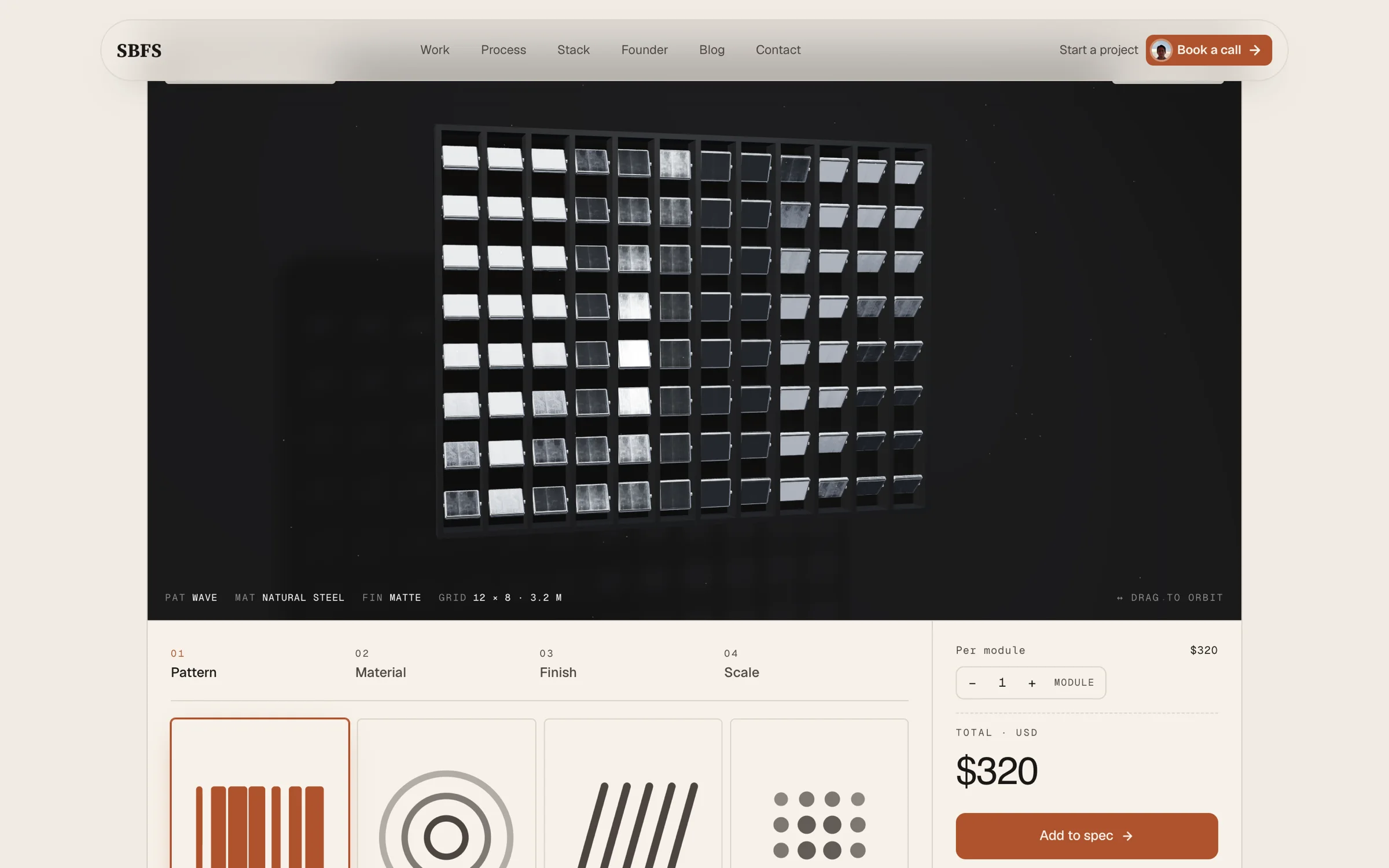
The configurator embedded in the SBFS home page: a 3D panel wall above pattern, material, finish and scale steps, with a live per-module price.
The configurator on this page — a real 3D scene, real option steps, a price that moves as you configure. Same libraries as the client builds.
Self-hosted
Same stack we ship to clients
CMS-driven
Pages and posts, editable in the admin
Shared core
Upgraded once, across every project
— The challenge

The problem

A studio that rebuilds authentication, an admin panel, a CMS, and a checkout for every client pays for the same work repeatedly, and every project drifts into its own dialect. The projects on this page needed to share one foundation — so a fix or an upgrade lands once and reaches all of them — without turning into a rigid template that fights each client’s actual product.
— What we built

The solution

01

One shared foundation, versioned

Auth, roles, the admin, content, and commerce primitives live in a single in-house framework that each project depends on by version — so upgrades are a deliberate bump, not a rewrite, and a fix made once reaches every build.

02

Content that the team can actually edit

This marketing site is not a static build: its pages are composed of CMS blocks and its blog posts are database records, so copy changes ship without a developer or a deploy.

03

The demo is the product

The configurator embedded on the home page is production code from the same libraries the client projects use — the fastest honest answer to “can you show me one that works?”.

— The product

What shipped

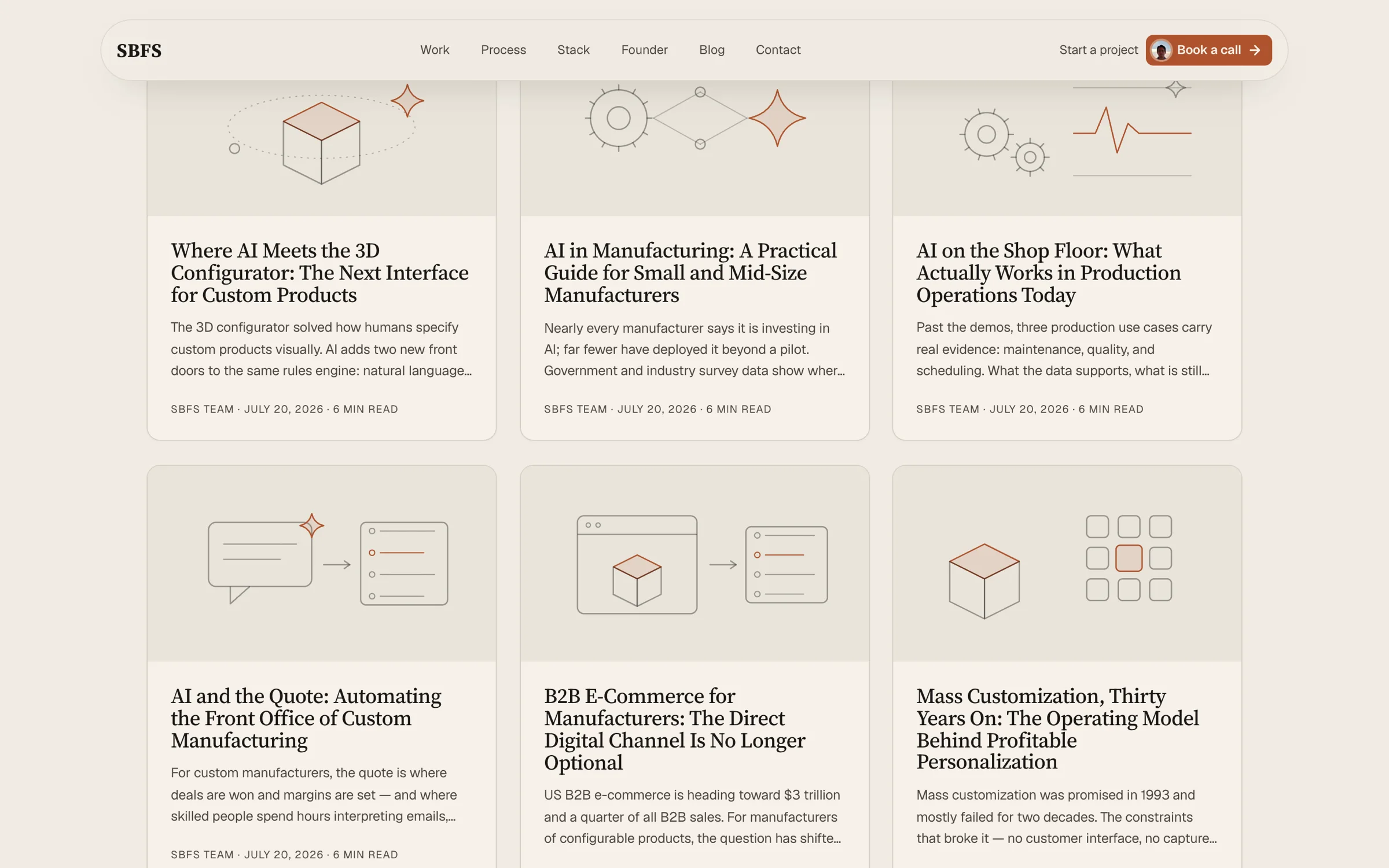
The SBFS blog index, listing published articles on configurable-product commerce.
The blog runs on the same CMS — no separate publishing tool, no second deploy.
— The outcome

What changed

The platform is the reason a second brand can launch in six weeks and a fix can reach every project at once — and this site is the part of it we can show you without a login: CMS-composed pages, a database-backed blog, and a working configurator, all running the same code the client work does.
Next.jsPostgresThree.jsVercelTypeScript

Building something configurable?

We build commerce platforms end-to-end for manufacturers of configurable products — configurator, checkout, and portal. Tell us what you make.

Start a project
SBFS© 2026 SBFS · Delaware C-Corp · Cali, Colombia
+57 314 804 3090·juan@sbfs.co·Top ↑
— Related reading

The thinking behind it

One System or Seven: What a Unified Platform Looks Like for Custom-Product Manufacturers

Read

The typical custom manufacturer runs a website builder, a configurator SaaS, a quoting tool, spreadsheets for production, and accounting software — glued together by re-typing. Here is the capability map of a unified platform, and the integration tax it eliminates.

6 min read

AI in Manufacturing: A Practical Guide for Small and Mid-Size Manufacturers

Read

Nearly every manufacturer says it is investing in AI; far fewer have deployed it beyond a pilot. Government and industry survey data show where AI is actually paying off in manufacturing — and why the adoption gap between large and small firms is an opening, not a verdict.

6 min read

Where AI Meets the 3D Configurator: The Next Interface for Custom Products

Read

The 3D configurator solved how humans specify custom products visually. AI adds two new front doors to the same rules engine: natural language — and, increasingly, other software. What stays deterministic, what becomes conversational, and how to be ready.

6 min read