A multi-brand commerce platform for manufacturers
A second brand should not mean a second everything. One platform carries several storefronts, each with its own catalog, pricing and identity, and a new brand launches on what you already run.
A second brand on a store that was already built, so the work went into the brand.

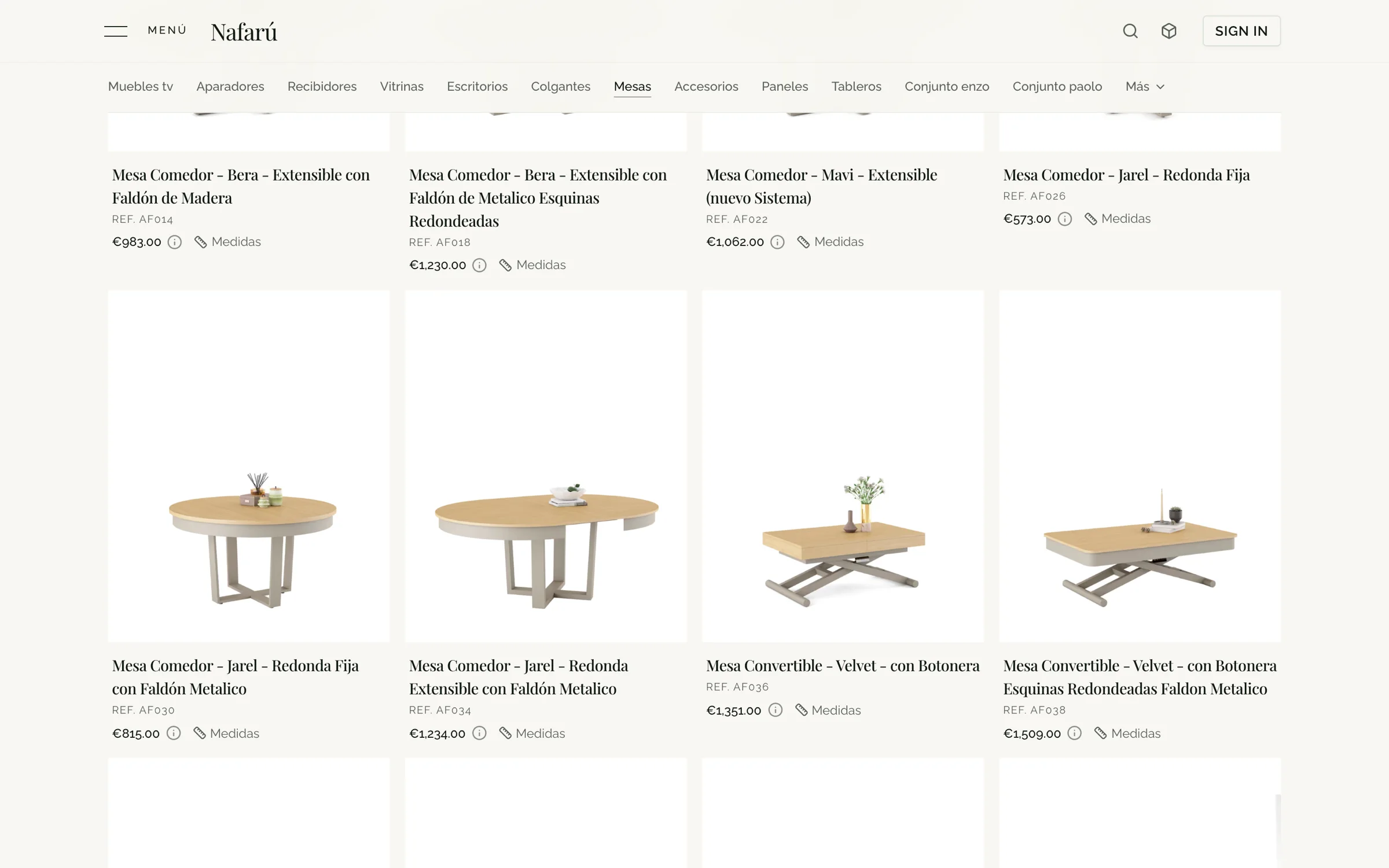
Nafarú’s dining range, a separate brand and catalog on the platform built for Muebles Torga.
SBFS built Nafarú's online configurator: Nafarú is a second retail brand for the group behind Muebles Torga, launched on the store SBFS had already built.
Launching a second retail brand normally means building everything twice: another storefront, another catalog, another checkout, another set of product rules to keep up to date.
The group wanted Nafarú on sale quickly, without doubling the cost and the effort of running two shops.
Nafarú runs on the same store as Muebles Torga, so an improvement is made once and both brands get it, instead of two shops slowly drifting apart.
The work went into identity, typography and the catalog itself (the parts that make a brand different) rather than rebuilding shop features that already worked.
Separate ranges, reference codes and prices per brand, so Nafarú reads as its own store to a customer, not as a copy of another one.
The store built for Muebles Torga carried a second brand without a second build: Nafarú launched with its own identity, catalog and pricing.
Both storefronts are maintained as one system rather than two.
A new brand reached customers with its own look, catalog and pricing, instead of waiting on a second store built from scratch.
Each brand sells its own ranges at its own prices, so Nafarú reads to a customer as a store in its own right.
Both storefronts run as one system: an improvement made once reaches both brands, so running two shops does not double the work.
Want this for your product? We set up a live demo of it, free. If you go ahead, we run the real one and keep it current. Tell us what you make.
A second brand should not mean a second everything. One platform carries several storefronts, each with its own catalog, pricing and identity, and a new brand launches on what you already run.
Furniture sells on choices: wood, size, finish, legs and edge, and modular ranges add parts that do not fit together. Your buyers see every choice priced, and the ones you cannot build never reach the order.